
Enrichment Activities for Dogs Home Alone: Tips for Busy Owners


A bored dog can turn a quiet house into chewed skirting boards, shredded posts, or a barking complaint.
Good enrichment gives your dog something better to do.
The goal is simple.
Help your dog use their nose, brain, and mouth safely while you are out.
The best setup doesn't have to be expensive.
It needs to suit your dog, your home, and how long they spend alone.
A calm setup helps dogs stay busy without chaos.
What enrichment means for dogs left home alone
Enrichment is any safe activity that allows a dog to engage in natural behaviours, such as sniffing, searching, licking, chewing, problem-solving, or resting in a secure spot.
Dogs do not need constant entertainment.
They need a healthy mix of activity and sleep.
Many dogs sleep for much of the day when their needs are met.
Trouble starts when they have too much unused energy, no clear routine, or nothing suitable to chew, lick, or explore.
Good enrichment can help with:
Mental stimulation
It gives your dog a job.
Calm behaviour
Licking, chewing and sniffing can help many dogs settle.
Confidence
Easy wins build a dog's willingness to try new tasks.
Less destructive behaviour
A dog with a safe chew is less likely to choose the sofa leg.
A smoother leaving routine
Predictable activities can make departures feel normal.
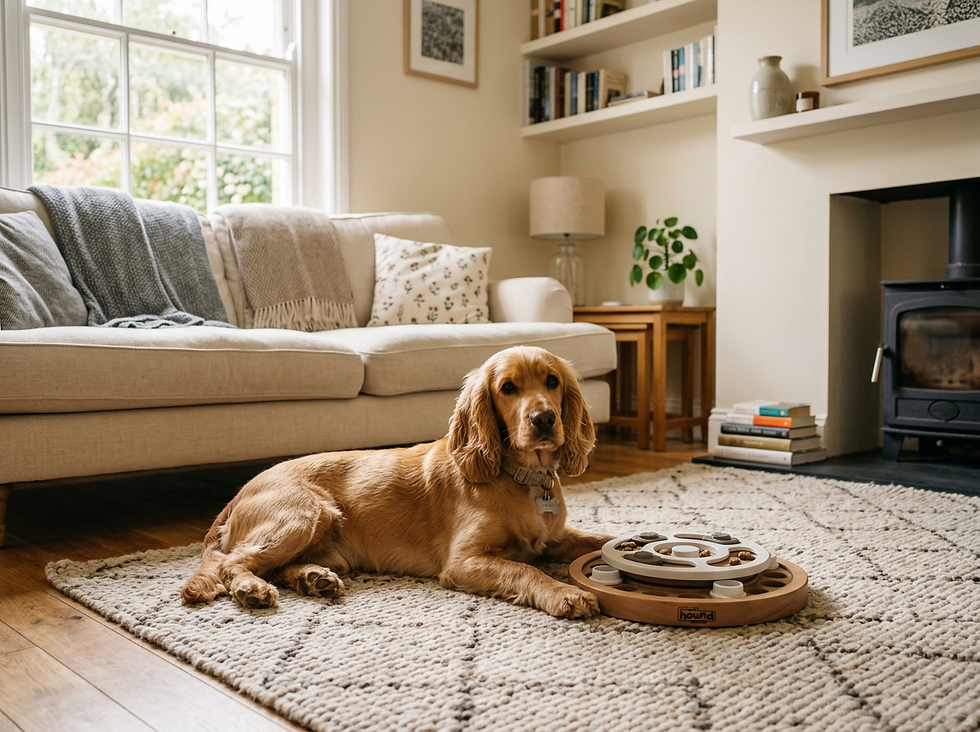
Enrichment will not fix severe separation anxiety on its own.
If a dog panics when left, barks for long periods, toilets indoors through stress or tries to escape, speak to a qualified behaviourist or your vet.
Toys cannot solve panic.
They can support a wider plan.
For most dogs, though, the right home-alone setup makes a clear difference.
Start with safety before you leave enrichment out.
Not every toy is safe for unsupervised use.
Some dogs gently lick a food toy for an hour.
Others can dismantle it in minutes.
Before leaving any activity with your dog, test it at home.
Watch how they use it.
Remove anything that cracks, splinters, frays or breaks into small pieces.
Use this quick safety check:
Check | What to look for |
Size | The toy should be too large to swallow. |
Durability | It should match your dog's chewing style. |
Fillings | Avoid anything that upsets your dog's stomach. |
Loose parts | Remove strings, staples, tape and small plastic bits. |
Environment | Keep the area free from cables, bins, shoes and unsafe items. |
Multiple dogs | Avoid food activities if dogs may guard resources. |
Some dogs need heavy-duty rubber toys.
Others do better with soft snuffle mats or cardboard puzzles.
Strong chewers, puppies and dogs who swallow objects need extra care.
When in doubt, keep it simple.
A safe chew in a dog-proof room beats a clever puzzle with loose parts.
The best interactive toys and puzzles for home-alone dogs
Interactive toys work well because they give your dog a clear task.
They create interest without needing a person in the room.
The best ones make your dog work at a steady pace.
If it's too easy, the game is over in two minutes.
If it's too hard, your dog may give up or get frustrated.
Food dispensing toys that reward effort
Food dispensing toys are a strong choice for many dogs.
They release kibble or treats as the dog rolls, nudges or paws at them.
They are useful because they turn a normal meal into a mini activity.
Instead of eating from a bowl in 30 seconds, your dog spends time moving, sniffing and thinking.
Good options include:
Rubber treat dispensers
Rolling treat balls
Wobble feeders
Slow feeder bowls
Maze-style feeders
Start with something easy.
Let plenty of food fall out at first.
Once your dog understands the game, make it harder by using larger pieces, adjusting the opening or mixing kibble with a few higher-value treats.
Use part of your dog's normal food allowance.
This helps avoid overfeeding.
It also makes daily enrichment easier to keep up.
Puzzle feeders for dogs who like a challenge
Puzzle feeders often have sliders, flaps, lids or compartments.
Dogs use their nose and paws to uncover food.
These can be excellent, but many work best when you are home.
Some dogs chew the plastic pieces if they cannot solve the puzzle.
Others flip the whole thing over and attack the base.
For home-alone use, choose sturdy designs with no removable parts.
If your dog is new to puzzles, practise together first.
A sensible progression looks like this:
Put treats in open compartments.
Partly cover the treats.
Add one simple moving part.
Increase difficulty only when your dog stays calm.
Stop if your dog paws hard, barks at it or chews the puzzle.
A good puzzle should feel like a fun search, not an exam.
Lick mats for calm enrichment
Lick mats are flat mats with ridges or grooves.
You spread soft food over the surface, and the dog licks it out.
They are useful before you leave because licking can calm many dogs.
They also work well during grooming, bath time or quiet periods.
Common toppings include:
Wet dog food
Mashed banana
Plain yoghurt, if your dog tolerates it
Pumpkin purée with no added ingredients
A thin smear of dog-safe peanut butter with no xylitol
Soaked kibble mashed into a paste
Freezing a lick mat makes it last longer.
Place it on a tray first so it does not smear food across the freezer.
If your dog chews mats, use them only under supervision or choose a more durable food toy.
Long-lasting chews that match your dog
Chewing is normal. It helps dogs explore, relax and satisfy a natural need.
The key is giving the right chew.
No single chew is best for every dog.
Size, age, tooth health and chewing strength all matter.
Very hard chews can damage some dogs' teeth.
Soft chews may disappear too fast for strong chewers.
Safer choices often include:
Durable rubber chew toys.
Stuffed rubber toys
Dental chews sized for your dog.
Natural chews from trusted pet shops
Puppy-safe chews for young dogs
Avoid cooked bones.
They can splinter.
Be careful with anything small enough to swallow.
If your dog tries to gulp chews, choose larger items or use a chew holder designed for that purpose.
Snuffle mats for dogs who love to sniff
A snuffle mat is a fabric mat with folds or strips where you can hide food.
Your dog searches through the fabric using their nose.
Sniffing is tiring in a good way.
Ten minutes of calm sniffing can feel more satisfying than frantic play for many dogs.
Snuffle mats work best for dogs that don't chew fabric.
If your dog pulls the mat apart, try scatter feeding in a safe area instead.
Make it more interesting by using different kibble shapes or placing the mat in a quiet corner away from distractions.
DIY enrichment ideas using household items
You do not need a cupboard full of expensive dog puzzles.
You can make many useful activities from common household items.
The same safety rules apply.
Skip anything with sharp edges, staples, tape, string or tiny parts.
Do not leave cardboard puzzles with a dog who eats cardboard.
The towel roll game
This is easy and cheap.
Lay a towel flat.
Sprinkle a small amount of kibble across it.
Roll it up loosely.
Let your dog push and unroll it to find the food.
For beginners, keep it loose.
For confident dogs, fold the sides in before rolling.
You can also use two towels for a longer search.
This works well because it uses the nose and paws and doesn't require much space.
The cardboard box rummage
Use a plain cardboard box.
Add crumpled paper and scatter kibble inside.
Your dog sniffs and rummages for the food.
Make it easy at first.
Leave the top open and use shallow paper.
Later, add more paper or place smaller boxes inside.
This is one of the simplest dog enrichment ideas for rainy days.
It's also a good way to reuse delivery boxes before recycling them.
Do not use glossy packaging, staples, plastic wrap or boxes that held cleaning products. Remove the box if your dog starts eating it.
The muffin tin puzzle
Place treats or kibble in a muffin tin.
Put tennis balls or safe dog balls over some of the holes.
Your dog has to move the balls to reach the food.
This is better as a supervised game for most dogs.
Some will carry the balls away or chew them.
Use it while you are getting ready, then swap to a safer home-alone toy when you leave.
The treat trail
A treat trail encourages calm searching.
Place small pieces of food along a safe route, such as from the kitchen to your dog's bed.
Keep the trail simple.
A few pieces are enough.
You want calm sniffing, not frantic hunting.
This can be useful as part of your leaving routine.
Your dog follows the trail, finds a food toy at the end and then settles in their usual space.
The recycling tube puzzle
Use the cardboard middle from a toilet roll or kitchen roll.
Fold one end, add a few bits of kibble, then fold the other end.
Some dogs love tearing these open.
Others eat the cardboard.
Watch your dog the first few times.
For a safer version, hide open cardboard tubes in a box of towels and let your dog sniff out the food.
Remove everything before you leave if your dog shreds or swallows.
Scatter feeding in the garden
If you have a secure garden, scatter part of your dog's meal on the grass and let them sniff it out.
This is simple and effective.
Grass holds the scent well.
It gets dogs to use their noses instead of gulping from a bowl.
Use common sense with weather.
Avoid frozen, muddy or treated grass.
Check the garden for hazards first.
If your dog barks at neighbours, wildlife or passing people, indoor sniffing games may be calmer.
Household items can turn mealtimes into useful brain work.

Training exercises that support home-alone enrichment
Training does not happen while your dog is fully alone.
It happens before you leave.
The aim is to teach skills that make alone time easier.
Short sessions work best.
Think three to five minutes at a time.
Stop while your dog is still engaged.
Teach a solid settle cue.
A settle cue teaches your dog to relax on a mat, bed or blanket.
Here is a simple way to start:
Place a mat on the floor.
Reward your dog for looking at it.
Reward any step towards it.
Reward paws on the mat.
Reward lying down.
Add a cue such as "settle".
Build duration slowly.
Once your dog understands, practise while you move around the room.
Then practise while you open a cupboard, pick up keys or put on shoes.
This teaches your dog that your movement does not always mean excitement.
Practise short absences
Dogs cope better when alone time builds up gradually.
Start with tiny absences.
Step behind a door for a few seconds.
Return before your dog becomes distressed.
Repeat at a level your dog can handle.
Build slowly.
Move from seconds to minutes.
Then add normal leaving cues, such as picking up your bag or putting on a coat.
Keep arrivals low-key.
Calm returns help your dog understand that leaving and coming back are normal.
If your dog panics right away, don't push through.
Get support from a qualified professional.
Use a release word for enrichment.
Teach your dog when they can start an activity.
This builds impulse control and creates a clearer routine.
Place a filled toy on the floor.
Gently hold your dog or ask for a sit.
Say a release cue, such as "find it" or "okay".
Then let them start.
Over time, your dog learns to wait for the cue.
This is useful if you set up a food toy before leaving.
Build confidence with easy wins.
Confidence matters.
A dog that succeeds at simple puzzles is more likely to stay calm when faced with new ones.
Try easy training wins such as:
Touching your hand with their nose
Finding a treat under one of two cups
Moving to their bed on cue
Picking up a toy
Waiting for a food bowl
Looking at you when you say their name
Keep rewards small.
Use food your dog enjoys.
End before they get tired.
Pair departure cues with good things
Many dogs notice patterns.
Shoes.
Keys.
Laptop bag.
Coat.
These cues can trigger worry before you even leave.
Change the meaning of those cues.
Pick up your keys, drop a treat, then sit back down.
Put on your coat, give your dog a chew, then take the coat off.
Repeat at random times.
This helps reduce the charge around leaving signals.
It will not cure serious anxiety, but it can help dogs who get mildly unsettled.
Create a routine that makes alone time predictable.
Dogs like patterns.
A clear routine tells them what comes next.
That makes home-alone time less confusing.
A good routine does not need to be rigid.
It needs to be consistent enough for your dog to understand.
Meet basic needs before enrichment.
Enrichment works best when your dog has had time to toilet, move, and connect with you.
Before leaving for work or errands, aim for:
A toilet break
A walk or sniff session suited to your dog
Fresh water
A safe resting space
A suitable food or chew activity
A calm goodbye
For some dogs, a slow sniff walk is better than a fast pavement march.
Sniffing lets them process the world.
It can help them settle when they get home.
High-energy play right before leaving can backfire for some dogs.
They may stay wired when you go.
If your dog gets overexcited, finish with calm sniffing or a lick activity.
Use a simple leaving pattern.
A predictable leaving pattern can reduce stress.
For example:
Toilet break.
Settle on bed.
Give food toy.
Put on coat.
Leave calmly.
Avoid long emotional goodbyes.
They can make leaving feel like a big event.
A quiet phrase such as "back soon" is enough if you want one.
Rotate activities through the week.
The same toy every day can become boring.
A full cupboard of toys all at once can become clutter.
Rotate a small set instead.
A weekly plan could look like this:
Day | Main activity | Good for |
Monday | Stuffed rubber toy | Licking and chewing |
Tuesday | Snuffle mat | Calm scent work |
Wednesday | Towel roll | Problem solving |
Thursday | Treat ball | Movement and focus |
Friday | Cardboard box rummage | Sniffing and novelty |
Saturday | Lick mat before rest | Calm downtime |
Sunday | Scatter feed | Natural foraging |
Adjust the plan to your dog.
If one activity causes frustration, remove it.
If one helps them settle every time, keep it in regular use.
Match enrichment to the length of absence
A ten-minute trip to the shop does not need the same setup as a half-day out.
For short absences, a small chew or a few scattered treats may be enough.
For longer absences, combine activities.
For example, do a sniff walk before you leave, then offer a frozen stuffed toy in a safe area.
Do not rely on one giant puzzle to fill several hours.
Most enrichment activities are short to medium length.
After that, your dog should be able to rest.
If your dog cannot settle after their activity ends, the issue may be the length of time alone, not the toy.
Set up a calm environment, not chaos.
The room matters as much as the toy.
A safe, comfortable space helps your dog make better choices.
Some dogs prefer a crate if they have been trained to love it.
Others prefer a gated kitchen, utility room, living room or dog-safe area.
The right choice is the place where your dog relaxes best.
Remove tempting hazards
Before you leave, do a quick scan.
Move or secure:
Shoes
Children's toys
Food bins
Loose cables
Remote controls
Cleaning products
Houseplants that may be unsafe
Post at the front door
Anything your dog has chewed before
If your dog raids the bin, don't leave it available.
If they shred post, use an external letterbox or, where possible, a hallway gate.
Good management is not cheating.
It prevents habits from forming.
Control noise and window triggers
Some dogs bark because the world keeps appearing at the window.
If your dog reacts to people, dogs, cars or delivery drivers, block the view.
Use blinds, frosted film or move their resting spot.
Background sound can also help.
A radio at low volume, soft music or white noise may mask sudden outside noises.
Keep it gentle.
Loud sound can add stress.
Test it while you are home.
If your dog moves away from the speaker, turn it down or switch it off.
Give your dog a proper rest zone.
A rest zone should feel safe and boring in the best way.
Include:
A comfortable bed
Fresh water
Safe flooring
Good ventilation
A normal room temperature
A chew or food toy if suitable
Enough space to stretch and change position
Avoid leaving your dog in direct sun in a conservatory or small room that heats up.
Weather can change fast, and some rooms get warm even on mild days.
Use cameras carefully
Pet cameras can help you learn what your dog does when alone.
They can show whether your dog settles, barks, paces or ignores their toys.
They are useful for information.
They aren't a fix on their own.
If the camera has a talk function, use it with caution.
Some dogs find a remote voice confusing.
Watch your dog's reaction before using it when you are away.
Choose enrichment by your dog's personality.
The best enrichment activities for dogs home alone UK busy owners can use are the ones their dogs actually enjoy.
Breed can play a role, but personality matters more.
A terrier may love shredding cardboard.
A retriever may prefer carrying a soft toy.
A scent hound may want long sniffing games.
An older dog may choose a lick mat over a treat ball.
Use your dog's behaviour as feedback.
If your dog is a strong chewer
Choose durable rubber toys and larger chews.
Avoid soft plastic puzzles.
Skip fabric toys when unsupervised.
Stuffed rubber toys can work well.
Pack them loosely at first.
If the toy is too difficult, your dog may chew the outside instead of working on the filling.
If your dog loves food
Food puzzles are a good match, but manage portions.
Use meals instead of extra treats.
Try slow feeders, snuffle mats and scatter feeding.
Mix in low-calorie options if your vet recommends them, especially for dogs watching their weight.
If your dog gets frustrated fast
Keep tasks easy.
Use open food toys, loose towel rolls and simple scatter feeds.
Frustration signs include barking at the toy, pawing hard, throwing it, whining or walking away.
Make the game easier next time.
If your dog is anxious
Focus on calm routines.
Use low-pressure licking and sniffing games.
Avoid noisy toys that bang into furniture.
For anxious dogs, success is not a complicated puzzle.
Success is eating calmly, resting and staying relaxed when you leave.
If your dog is older
Senior dogs still need mental stimulation.
They may need gentler options.
Use soft food toys, low mats, easy scent games and short training sessions.
Avoid anything that requires lots of twisting, jumping or hard chewing.
If your older dog's behaviour changes, speak to a vet.
Pain, hearing loss, or changes in eyesight can affect how they cope alone.
Common mistakes that make enrichment less effective
A few small mistakes can turn a good idea into a problem.
Making the puzzle too hard
Harder does not mean better.
A good activity should be achievable.
Your dog should finish feeling satisfied, not wound up.
Start easy.
Build slowly.
Using enrichment only when leaving
If the best toy appears only when you go out, some dogs learn that the toy predicts absence.
Use enrichment while you are home too.
Give a lick mat during quiet time.
Use puzzle feeders for dinner.
Practise settle games on normal evenings.
This makes enrichment part of daily life, not a signal that you're leaving.
Giving too much at once
Too many toys can create excitement rather than calm.
Choose one main activity for each absence.
Add a safe chew if needed.
A tidy setup helps your dog settle.
Ignoring body language
Watch what your dog tells you.
Good signs include:
Loose body
Calm sniffing
Steady licking
Choosing to lie down after the activity
Eating at a normal pace
Stress signs include:
Panting when not hot
Pacing
Whining
Barking at the door
Ignoring food
Scratching exits
Destructive chewing
Toileting indoors
If stress signs appear often, reduce the time alone and seek help.
A practical home-alone enrichment plan
Here is a simple plan for a weekday morning.
Before leaving
Take your dog for a toilet break and sniff walk.
Keep the final few minutes calm.
Offer water when you return.
Set up their rest area.
Remove hazards.
Close blinds if outside movement triggers barking.
Prepare one main activity.
A frozen stuffed toy, snuffle mat or safe chew works well for many dogs.
As you leave
Give the activity in the same place each time.
Use a simple cue if your dog knows one.
Leave without fuss.
Do not hover in the doorway.
That can create tension.
After you return
Keep greetings calm, especially if your dog is excitable.
Let them toilet.
Pick up any leftover chews or toys that shouldn't be left out.
Check what happened.
Did they finish the toy calmly?
Did they move their bed?
Was there chewing, barking or toileting?
Use that information for next time.
For a longer day
If your dog is alone for longer than they can handle, enrichment will not be enough. Arrange help where possible.
That could be a trusted family member, neighbour, dog walker or dog day care suited to your dog.
Dogs are social animals.
They also need toilet breaks and movement.
A food toy cannot replace those needs.
FAQ
How long can I leave my dog home alone with enrichment?
It depends on age, health, training and temperament.
Adult dogs who are comfortable alone may cope for a few hours.
Puppies, senior dogs and anxious dogs often need shorter periods.
Build time gradually and watch your dog's behaviour.
What is the best toy for a dog home alone?
A durable food dispensing toy is a good starting point for many dogs.
It should be the right size, hard to destroy and easy enough for your dog to use.
Test it at home before leaving it out.
Are cardboard enrichment games safe for dogs?
They can be safe for supervised play if your dog doesn't eat cardboard.
Remove tape, staples, and plastic.
Do not leave cardboard with dogs who shred and swallow it.
Should I leave the TV or radio on for my dog?
Low background sound can help some dogs by masking outdoor noise.
Others do not care or may dislike it.
Test it while you are home.
Keep the volume low.
What if my dog ignores enrichment when I leave?
A dog who ignores favourite food or toys may be stressed.
Make absences shorter and practise calm leaving routines.
If the behaviour continues, speak to a qualified behaviourist or your vet.
The best enrichment is simple, safe and consistent.
Home-alone enrichment works best when it fits your dog's real life.
Use safe toys.
Add easy DIY games.
Practise settle skills.
Keep routines calm.
Set up the room so your dog can relax.
Start with one change this week.
Swap the food bowl for a puzzle feeder.
Try a towel roll.
Build a better leaving routine.
Watch what helps your dog settle, then do more of that.
A busy dog does not need a house full of gadgets.
They need the right activity, in the right place, at the right time.


Comments